x.com

Three Crypto Startups That Shut Down This Week — and What Each One Got Wrong
Between May 20–21, 2026, Syndicate Labs (a16z-backed, ~$28M), Fantasy Top (Dragonfly-backed, ~$5.6M), and Everclear (Pantera-backed, ~$21.7M) all shut down. Three different root causes — mistimed market consolidation, structural PMF failure, and burn rate — with direct founder quotes and one replicable lesson each.
Between May 20 and 21, 2026, three Web3 infrastructure and application companies announced shutdowns on the same two-day stretch. Combined, they had raised roughly $55 million. Two of the three processed hundreds of millions of dollars in transaction volume. All three had credible backers and technically functional products. None found a path to sustainable revenue before money ran out.
The three cases cover different failure modes: a market structure that consolidated in the wrong direction, a product that front-loaded all its traction through incentive-driven launches and never found organic demand, and a protocol that converted real transaction volume into insufficient revenue and lost the race against its own runway. The root causes are distinct. The lessons don't overlap.
| Company | Founded | Vertical | Total raised | Root cause | Shutdown type |
|---|---|---|---|---|---|
| Syndicate Labs | 2021 | Ethereum rollup infrastructure | ~$28M | Mistimed market — L2 consolidation | Wind-down, code open-sourced |
| Fantasy Top | 2023/2024 | SocialFi trading card game | ~$5.6M | Product-market mismatch | Wind-down, investors refunded 100% |
| Everclear (Connext) | 2017 | Cross-chain clearing protocol | ~$21.7M | Burn rate + failed B2B pivot | Full protocol shutdown, TVL extracted |
Syndicate Labs: five years, $28M, and a rollup market that moved on
Syndicate Labs shut down on May 21, 2026, five years after co-founders Will Papper and Ian Lee started the company in 2021. The closure announcement came via a thread on X from the official @syndicateio account, which acknowledged the core problem in plain language: "The rollup market has shrunk dramatically. For every new rollup spinning up, several more are quietly shutting down." 1
What the company was building
Syndicate began as a DAO (Decentralized Autonomous Organization) investment infrastructure protocol — a platform for spinning up on-chain investment clubs — and raised a $20M Series A in August 2021 led by Andreessen Horowitz (a16z), with over 150 investors participating including Alexis Ohanian (Reddit co-founder) and Electric Capital. 2 A further $6M strategic round from OpenSea and Circle followed in May 2022, by which time roughly 1,200 investment clubs had launched on the platform. 3
At some point after 2022 — the specific timing was not publicly announced — Syndicate pivoted from DAO infrastructure to Ethereum rollup infrastructure: customizable EVM rollup frameworks and programmable sequencers designed for developers who wanted to launch their own application-specific chains.
The market structure trap
By 2025, Ethereum's Layer 2 ecosystem had consolidated sharply. Arbitrum One, Base, and OP Mainnet collectively controlled roughly 75% of L2 market share; the top five rollups held close to 90% of L2 liquidity. 4 L2 total value secured (TVS) dropped roughly 36% from a peak above $50B in October 2025 to approximately $32B by May 2026. 4 Research from 21Shares published in December 2025 reported that L2 active activity had declined 61% since June 2025, with multiple smaller chains described as "zombie chains." 4
The bigger structural shift was qualitative: demand moved away from standardized, reusable rollup frameworks and toward custom chains built from scratch by specialized consulting teams. Syndicate's official statement described it directly: "EVM rollups are no longer the standard. Instead, custom chains are being built by consulting teams from scratch, with very little reusable tech or network value." 1
This left Syndicate's framework in an awkward position. Will Papper explained the positioning problem in his own post-shutdown statement: "Our framework doesn't fall into either category. It's too specific to work as a generic primitive, and not close enough to the execution client to be extended into specific apps." 1 The team explored a pivot to a consulting-style rollup-as-a-service business but concluded the product couldn't adapt to what that model required.
The SYND token collapse and bridge exploit
Syndicate's SYND governance token launched in September 2025 at roughly $2.61. 5 On April 29, 2026, an attacker exploited a vulnerability in the Commons Bridge — a cross-chain bridge in the Syndicate ecosystem — stealing approximately 18.5M SYND tokens and selling them for roughly $330,000. 6 SYND fell 36% that day to $0.022; by the day of the shutdown announcement three weeks later, it had dropped to an all-time low near $0.01 — a 99.5% decline from its September 2025 peak. 5
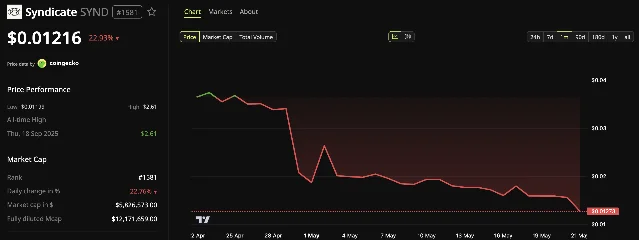
Syndicate was explicit that the exploit did not cause the shutdown — all affected users were compensated from treasury reserves — and that neither team members nor investors profited from SYND. Papper stated: "I can assure you that I made $0 from SYND. I even took no salary for a long time to preserve our team." 5 SYND tokens held by team members and investors remain locked. The codebase is being permanently open-sourced, and governance has been handed to an independent Wyoming DUNA called the Syndicate Network Collective.
Ian Lee, the other co-founder, posted his own statement: "We gave it everything we had through multiple market cycles. We explored every path. But in the end, we were unable to build a sustainable development company." 7
Root cause: Mistimed market. Syndicate made a directional bet on standardized rollup tooling at the moment the L2 market was consolidating toward a small number of dominant chains and a handful of bespoke custom builds. There was no version of the company's existing product that fit either side of that consolidation. The team recognized the structural shift too late to pivot to a meaningfully different business.
Replicable lesson: Infrastructure layer bets are market-structure bets. If your product depends on fragmented demand staying fragmented — many teams building rollups, each needing your tooling — model what happens when two or three dominant platforms absorb 80% of that demand. Build in a specific tripwire: at what concentration level does your TAM drop below the revenue threshold you need to survive?
Fantasy Top: 34,000 launch-week users, $0 left for anyone to build on
Fantasy Top, a SocialFi (social media meets DeFi) trading card game built on the Blast L2 network, announced its shutdown on May 20, 2026. 8 Kipit (@0xKipit), the pseudonymous lead founder, said the team had been operating for two and a half years — and included an unusual detail in the announcement: every pre-seed and seed investor was being refunded 100%, dollar for dollar. 8 The final tournament runs June 18, 2026, and the platform goes dark at the end of June.
The product and the launch spike
Fantasy Top's game mechanic involved purchasing NFT card packs of crypto influencers (called "heroes") from the Crypto Twitter ecosystem, then fielding five-card lineups in weekly tournaments. Hero scores updated hourly based on engagement metrics — likes, retweets, replies, follower reach — calculated from X (formerly Twitter) data. Cards had rarity tiers ranging from Uncommon (1× multiplier) to Legendary (2.5×). The most expensive single hero card sold for 3 ETH (~$9,000 at launch). 9
The May 2024 mainnet launch on Blast produced numbers that would have seemed to validate the model. In the first week alone: roughly 34,000 unique users, $24M in trading volume, $9.31M in protocol fees. 10 The platform entered DeFiLlama's top-five fee protocols that week. Fantasy Top also received $12.2M in Blast ecosystem incentive tokens as part of the Blast airdrop campaign — a program Blast used to attract projects to its chain. 11
Why the launch was a mirage
The first-month numbers turned out to be nearly the entire story. Kipit disclosed in the shutdown post-mortem: "At peak we had around 15k DAU, heavily boosted by Blast incentives. Fantasy distributed $12M in Blast tokens. This external incentive led us to generate around 70% of our total revenue in the first month of existence. Since then, it was mostly down only." 11
By June 2025 — roughly 13 months after launch — monthly fees had fallen 93% to approximately $200,000, and active users had dropped 80% to roughly 2,000. 12 The account cohort data told the same story: 82% of all accounts were created before mainnet launched, and 90% within the first month. Fewer than 10% of accounts joined after June 2024. 13 In February 2026 — the month of the final tournament — only 1,641 unique players registered. 13
The Blast ecosystem's collapse compounded the problem. Blast TVL had peaked at $2.2B in May 2024 and shrunk 95% to $87M by July 2025, when Fantasy Top migrated to Base. 14 Fantasy Top had been generating 83% of Blast's protocol revenue — meaning the migration wasn't optional so much as inevitable.

Five pivots, none of which worked
The team was not passive. Over 2.5 years, Kipit described five distinct attempts to escape the retention problem:
- Arena mode — reduced the barrier to asset ownership by letting users participate without holding full card sets
- Free-to-play (F2P) — introduced a no-cost entry tier to expand the top of funnel
- Clout point system — a B2B and InfoFi (information finance) mechanism designed to attract users interested in X analytics, then funnel them into the game
- Monad and Base expansion — distribution experiments by deploying on additional chains
- Social prediction market — the most radical pivot: removed the NFT economy entirely and replaced it with a social prediction mechanic, keeping the attention-data-as-game-input logic while eliminating the financial asset layer
None reached what Kipit called "durable market fit." 11 By the time the team was spending more on tournament rewards each week than it was earning in fees, the diagnosis was unambiguous: "We are spending more every week in tournament rewards than we generate in revenue. This is not PMF, it's subsidized retention." 11
Kipit's structural diagnosis
In the shutdown post-mortem, Kipit offered what is probably the most analytically useful takeaway from this failure: the problem wasn't execution — it was a structural incompatibility between the crypto TCG model and the audience it actually attracted.
Traditional trading card games build audiences through gameplay first: collect cards, build competitive decks, play other players, then a secondary market develops for rare cards as a side effect of gameplay value. Crypto TCGs invert this. The entry mechanic is financial speculation — buy cards hoping they appreciate — which attracts traders and speculators rather than players. Kipit: "We tried to put crypto on top of a model that was never built for crypto. Every crypto TCG has failed. TopShot, SoRare, and now us. This isn't a coincidence. It's structural." 8
On the question of tokens: Fantasy Top never issued a native token, and Kipit's explanation for why is worth quoting at length for any founder currently weighing the decision. "A token before product-market fit is poison. Every employee thinks about the price. Every user thinks about the price. You stop building and start managing sentiment." 8 The fact that the company could return investor capital 100% is a direct result of never spending those funds — the product funded itself through fees until those fees dried up.
Root cause: Product-market mismatch — structural. The game attracted speculation-motivated users, not gameplay-motivated users. These two user types have different retention curves, different price sensitivity, and different exit triggers. No amount of feature iteration changes the underlying user psychology of "I hold this card as a financial position" into "I play this game for fun."
Replicable lesson: Week-1 traction generated by token incentives or launch campaigns does not validate PMF. The meaningful metric is whether users return and engage after the incentive expires. If 70% of your lifetime revenue comes from the first month and 90% of your users never return after week four, the incentive worked and the product didn't. Run that analysis before your next funding round, not during your shutdown announcement.
Everclear: $500M monthly volume, zero sustainable revenue
Everclear (originally Connext), a cross-chain clearing and settlement protocol, shut down all operations on May 21, 2026. 16 The foundation, labs unit, and protocol itself all closed simultaneously. The UI went offline. The Everclear-specific chain stopped operating. All user and partner deposits were extracted before shutdown. The official announcement noted a possible $50,000–$200,000 token buyback after liabilities are settled, but described it as "not certain." 17
Nine years from Connext to shutdown
Arjun Bhuptani and Layne Haber founded Connext in 2017 — Bhuptani had been an early Ethereum researcher, and both had co-created Moloch DAO, a grant-making governance structure that became a template for crypto-native organizations. 18 The company accumulated $21.7M in total funding across multiple rounds: a $2.2M seed in March 2021 led by Polychain Capital; a $12M round in July 2021 with Coinbase Ventures and Ethereal Ventures; a $7.5M strategic round in June 2023 at a $250M valuation with Polychain Capital, Coinbase Ventures, and NGC Ventures; and a $5M OTC transaction from Pantera Capital in June 2024. 19 18
The June 2024 rebrand from Connext to Everclear came with a new framing: a "clearing layer" that would coordinate cross-chain transactions through competing third-party solvers (automated liquidity providers), built on an Arbitrum Orbit rollup using Hyperlane for cross-chain messaging and EigenLayer for security. 18 Pantera Capital, in its investment post, described chain abstraction as inevitable and Everclear as the foundational clearing layer for it. 20 Mainnet launched in April 2025, and by the time of shutdown the protocol had processed over $1.5B in cumulative volume with a monthly transaction peak of $500M. 16
The volume-to-revenue gap
The protocol's shutdown statement articulated the business problem with unusual directness: "Despite reaching $500M in monthly volume, the cross-chain solvers segment never developed the commercial depth we needed — users proved highly price-sensitive, and we were unable to convert that volume into meaningful revenue." 16
Cross-chain bridges and clearing protocols operate in a race-to-zero fee environment. Users route their transactions through whichever solver offers the best rate at the moment of execution; there is no meaningful switching cost or loyalty. High nominal volume does not imply high margins — the cost of running the solver network and maintaining infrastructure can exceed the fees earned per transaction. FinanceFeeds summarized the problem: "High nominal transaction volume, if the marginal economics of each transaction are negative, doesn't equal profitability." 21
The B2B pivot and the runway gap
In the final six months of operation, Everclear shifted strategy from B2C transaction fees toward a B2B2C model: long-term contracts with protocols and enterprises that needed automated cross-chain liquidity rebalancing. The logic was sound — enterprises have higher switching costs and would generate recurring, predictable revenue rather than razor-thin per-transaction margins.
The execution ran into the standard B2B timeline problem. The team's post-shutdown statement: "Several significant names signed on, but we underestimated how long it would take those partners to go live — and our runway ran out before they did." 16 Enterprise B2B sales cycles in crypto infrastructure run 6–18 months from signed contract to live integration. The company's last funding event was the $5M Pantera OTC deal in June 2024, roughly 23 months before the May 2026 shutdown — suggesting the company was operating on a lean budget throughout the period.
The CLEAR token — which had migrated from the original NEXT token in 2024 — fell 48% on the shutdown announcement day, declining to $0.000231. 22 Its market capitalization shrank to approximately $199,000. CLEAR had declined roughly 99.7% from its January 2025 all-time high. 23
リンクプレビューを読み込んでいます…
Bhuptani's personal shutdown post recounted the nine-year technical history: the first production Layer 2 state channel in 2018, co-creating Moloch DAO, pioneering the intent-based bridge model, advancing the ERC-7281 (xERC20) cross-chain token standard, processing over $6B in lifetime network volume. 24 He added: "Even though this isn't the ending we ultimately wanted, I am incredibly proud of what our team has accomplished." He committed to publishing a more detailed post-mortem and noted the team is open to hiring opportunities: "We have a team of 10x operators who have executed ruthlessly through some of the harshest market conditions on shoestring budgets." 24
Root cause: Burn rate + failed pivot. The original solver-based business model could not generate margins sufficient to sustain operations. The B2B pivot identified a plausible path to sustainable revenue, but B2B implementation timelines are long and fixed, while startup runway is short and finite. The company ran out of money before any B2B contract went live.
Replicable lesson: If you pivot to B2B during a burn-rate crisis, model time-to-first-revenue conservatively — 12 months from signed contract to cash in the door is closer to the median than the exception in enterprise software. The decision to pursue B2B should be made with at least that much runway remaining. A signed LOI does not extend your operational runway.
What these three cases have in common
Three different companies, three different failure modes — but two patterns appear in all of them.
Each company was right about the problem but wrong about the timing. Rollup infrastructure was a genuine need in 2021; the market just consolidated before Syndicate's product could capture it. SocialFi games built on social graph data are a real design space; the specific execution mechanics of crypto TCGs reliably attract the wrong user type. Cross-chain clearing is necessary infrastructure as the multi-chain world expands; solver models just can't extract margin in a price-sensitive environment. In each case, the thesis was defensible at the time of the investment decision. The market moved in a direction that made the specific bet wrong even when the general thesis held.
Incentive-driven metrics are not the same as product-market fit. This applies most explicitly to Fantasy Top — 70% of lifetime revenue from month one — but the dynamic appears across all three. SYND token incentives tied team and investor interests to a token whose value depended on a growing rollup ecosystem; when that ecosystem consolidated, there was no non-token business case to fall back on. Everclear's $500M monthly volume was real but margin-free. Metrics that require ongoing subsidies or external incentives to exist are not proof that users value your product; they're proof that users value the incentive. The useful test is simpler: what do your retention numbers look like in the cohort of users who joined after the incentive campaign ended?
The integrity question is also worth noting: all three teams did the responsible thing when they decided to stop. Syndicate locked tokens and compensated exploit victims from its own reserves. Fantasy Top returned 100% of investor capital — which Kipit was blunt about being possible only because the company had never spent it: "We can do this because we never had to spend the money to operate. The business funded itself." 11 Everclear extracted all TVL before shutdown so no user funds were stranded. These are not small choices — they're worth naming explicitly in an industry where shutdown mechanics frequently harm users and retail holders.
Cover image from The Block: Everclear winds down protocol
参考ソース
- 1The Block: Syndicate Labs to wind down operations after five years
- 2CoinDesk: a16z, Ohanian, Snoop Dogg Back DAO-Builder Syndicate in $20M Series A
- 3CoinDesk: OpenSea and Circle Back $6M Raise for DAO Platform Syndicate
- 4Cryptonews: Syndicate Labs Shutdown — Is the Ethereum L2 'Great Shakeout' Here?
- 5BeInCrypto: SYND Crashes to All-Time Low as Syndicate Labs Announces Wind-Down
- 6The Block: Syndicate suffers exploit linked to Commons bridge compromise
- 7Ian Lee (@ianDAOs) on X
- 8The Block: Fantasy Top to shut down, says trading card game model was 'never built' for crypto
- 9DL News: What is fantasy.top?
- 10The Defiant: Fantasy.Top Blasts Off But Faces Malicious Bot Activity
- 11KuCoin News: Fantasy Shuts Down After 2.5 Years, Reflects on SocialFi Lessons
- 12DL News: SocialFi project fantasy.top ditches Blast for Base
- 13@0xKipit on X: response to 'slow rug' allegations
- 14PANews: Fantasy.top, the ecological 'flag bearer', has left — What happened to Blast?
- 15Crypto Briefing: Fantasy Top to shut down after two years
- 16The Block: CLEAR token tanks 48% as Everclear winds down protocol
- 17Yahoo Finance via BeInCrypto: Everclear and ZERO Network Shutdowns Add to Growing List of 2026 DeFi Closures
- 18The Block: Connext rebrands to Everclear
- 19CoinCarp: Everclear Funding Rounds & Investors
- 20Pantera Capital: Investing in Everclear
- 21FinanceFeeds: Everclear Winds Down After $500 Million Monthly Volume Fails to Pay Off
- 22crypto.news: CLEAR collapses 48% as Everclear shuts down protocol
- 23BigGo Finance: Cross-Chain Protocol Everclear Shuts Down as Funds Run Dry
- 24Arjun Bhuptani (@arjunbhuptani) on X
このコンテンツについて、さらに観点や背景を補足しましょう。