Supreme: How a Skater's Inventory Problem Became Fashion's Most Copied Business Model

Supreme: How a Skater's Inventory Problem Became Fashion's Most Copied Business Model

In 1994, James Jebbia opened a skate shop on Lafayette Street with no money for inventory. He couldn't keep the shelves full, so he ordered less, sold out, and made something different next week. That cash-flow constraint became the drop model — and 30 years later, the brand it built has changed hands three times, shed $600 million in its last sale, and left the entire fashion industry trying to reverse-engineer something that was never designed to be copied.
品牌史志
2026/5/25 · 8:08
購読 7 件 · コンテンツ 6 件
In 1994, James Jebbia opened a shop on Lafayette Street in Lower Manhattan with no money for inventory. He couldn't keep the shelves full, so he ordered less, sold out, and ordered something different. Thirty years later, that cash-flow problem had a name — "the drop model" — and every major brand in fashion had copied it. This is how Supreme happened.

The kid from Crawley who wound up in SoHo

Jebbia grew up in Crawley, West Sussex, spending his wages from a Duracell factory on trips to London to buy clothes from the kind of shop he would later describe as "the cool, cool shop — the shop that carries the cool stuff that nobody else has."1
At 19, he moved to New York and took a job at Parachute, a futuristic fashion brand on Wooster Street, across the street from the original Comme des Garçons boutique. He ran a table at the nearby flea market. Then, in 1989, he opened Union on Spring Street — a boutique carrying mostly British brands that found its audience by stocking Shawn Stüssy's clothing. That went so well that Jebbia wound up co-running the first Stüssy store in New York, on Wooster Street, before Stüssy retired and left him with the question of what to do next.2
"I always really liked what was coming out of the skate world," Jebbia later said. "It was less commercial — it had more edge and more fuck-you type stuff."2 SoHo had Union, Stüssy, Triple 5 Soul, and XLarge. One piece was missing: a skate shop.

The store that wasn't really a store

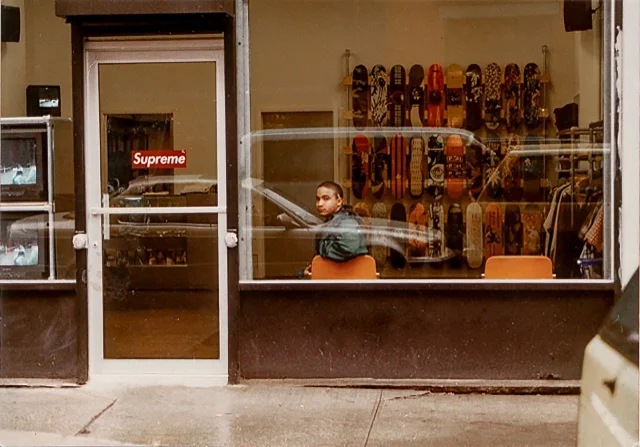
Lafayette Street in 1994 was quiet — antiques shops, a firehouse, a machinist, and a Keith Haring store. Jebbia took a former office space and built something spare. Clothes arranged around the perimeter. Music cranked. A video monitor playing Muhammad Ali fights and Taxi Driver on loop. The first employees included skateboarders and downtown kids who had been extras in Larry Clark's Kids — among them Justin Pierce and Harold Hunter.3
Filmmaker Harmony Korine, who had moved two blocks away months before, later described it as "a hangout spot for that specific crew" rather than a business.2 The kids working the floor were cool and opinionated — notably scowling at anyone they deemed uncool — which was exactly the point. Being slightly unwelcoming was, paradoxically, the strongest possible advertisement.
The logo came from Barbara Kruger, whose text-and-photo-collage artwork Jebbia had encountered in a book. A red rectangle. White Futura Heavy Oblique type. It appeared on T-shirts almost as an afterthought — initially, Supreme barely made clothing at all.3

Why the shelves were always empty — and why it worked

Jebbia had no capital to maintain steady inventory. So he ordered small runs of T-shirts and hoodies. When they sold — and they did, quickly — he made something different instead of restocking the same item.
"We'd make some tees, some sweats; if they don't sell, we're going to be stuck with them," he said. The solution was to produce less. "If something sold well, instead of manufacturing more of that thing, he'd often make something different."2 Some seasons the summer product sold out by late March. Customers arriving in May walked into an empty shop. Word spread anyway.
By the late 1990s, Jebbia had formalized this into a weekly release system: every Thursday, a small group of new items hit the shop and the nascent website. The schedule created urgency that no advertising budget could replicate. If you missed this week's drop, it was gone. Something new would arrive next Thursday, and the week after that.4
This wasn't a planned retail innovation. It was the structural consequence of running a small business on thin margins, iterated into a system. Supreme's first website launched in 2006 — purposefully late, and by design minimalist. Instagram came even later, and only as an "exhibit space," in Jebbia's words, not a marketing channel.1
リンクプレビューを読み込んでいます…
Supreme on Lafayette Street, 1995 — skaters outside, minimal interior
Supreme's original Lafayette Street store, 1995. 2

Japan, collaborations, and the luxury breakthrough

Supreme opened its first Tokyo outpost in Daikanyama in 1998, its second location anywhere.5 Japanese consumers had an appetite for exactly what Supreme was offering — limited, high-quality garments with cultural credibility — and the Japanese market became a core part of the brand's identity. By 2019, Supreme had six locations in Japan alone.
Collaborations began almost immediately. The first was with the artist Rammellzee in 1994 — hand-painted trucker hats and backpacks.3 Through the 2000s, Supreme partnered with Nike SB (starting in 2002), Comme des Garçons, Vans, The North Face, and a rotating catalog of artists including Jeff Koons, Damien Hirst, and Richard Prince.
The collaboration that changed the brand's position in fashion came in 2012: Comme des Garçons. "I think that opened a lot of doors, a lot of eyes," Jebbia said.1 CDG president Adrian Joffe, Rei Kawakubo's husband, later said: "I have never met anyone with such a strong, single-minded vision who has always stayed close to his sense of values."
The culmination came in January 2017, when Supreme appeared on the Louis Vuitton runway at Paris Fashion Week Men's. Kim Jones, then Vuitton's menswear director, put skate trunks, LV-monogrammed Supreme hoodies, and joint accessories on the catwalk. The collection landed in pop-up shops across Sydney, Seoul, Tokyo, Beijing, Paris, London, Miami, and Los Angeles.3 For much of the fashion world, it was the first time they had looked closely at Supreme. For Supreme, it changed nothing about how the brand operated.
In 2018, Supreme won the Council of Fashion Designers of America Menswear Designer of the Year award. Jebbia accepted it in a gray suit with no tie, and said: "I've never considered Supreme to be a fashion company, or myself a designer, but I appreciate the recognition for what we do."2

The silent investor — and then the buyout

What remained hidden for years was that Supreme had already accepted outside money. In 2014, a private equity firm called Goode Partners took a minority stake in the company. This was kept quiet — Jebbia valued his independence and his image, and private equity backing contradicted both.6
In October 2017, two months after Jebbia posted on Instagram that Supreme had "no intentions of expanding" and that its limited supply was what drove demand, he sold a 50% stake to The Carlyle Group for $500 million — valuing the company at $1 billion. Carlyle, which typically buys controlling stakes and installs its own management, made an unusual exception. Jebbia stayed in charge.7
Three years later, in November 2020, VF Corporation — the parent company of The North Face, Vans, and Timberland — announced it was buying Supreme for $2.1 billion in an all-cash deal. VF bought out Carlyle, Goode Partners, and Jebbia himself.8 Jebbia remained as CEO to manage the business.
The timing was not ideal. The deal closed in December 2020, mid-pandemic. VF needed Supreme to reach $500 million in revenue for fiscal 2022, which required significant expansion — more merchandise, more stores. This was precisely the opposite of what had made Supreme work.

The scarcity paradox

VF Corp's thesis was that Supreme's model could scale. The problem, as Matt Powell of the consultancy Spurwink River put it bluntly: "The whole premise behind Supreme and other streetwear brands is that the product is hard to get. It's scarce. And scarcity and growth are really oppositional with each other."5
Under VF, Supreme opened new stores in Berlin, Milan (2021), Chicago (2022), a new Los Angeles location on Sunset Boulevard (2023), Seoul (2023), and Shanghai (2024). The brand grew to 17 locations worldwide.3 Every new store added access; access eroded the brand's core value proposition.
Revenue in fiscal 2023 slipped 7% to $523 million. VF took a $735 million goodwill impairment charge against Supreme that year. Search volume for "Supreme" dropped nearly 30% between May 2022 and May 2024. On StockX, Supreme's share of the apparel resale market fell from 36% in 2020 to 16% in 2024. For the first time in StockX's history, Supreme was no longer the top apparel brand on the platform.5 On eBay, searches for Supreme collections from the 1990s and 2000s jumped 100% and 85%, respectively, year-over-year — collectors were buying back the version of the brand that VF hadn't touched.
リンクプレビューを読み込んでいます…

The second sale, at a loss

In July 2024, EssilorLuxottica — the Italian-French eyewear group that owns Ray-Ban and Sunglass Hut — announced it was buying Supreme from VF Corporation for $1.5 billion. That was $600 million less than VF had paid four years earlier.9 VF acknowledged in the announcement that there were "limited synergies" between itself and Supreme.
Revenue for the fiscal year ended March 2024 had ticked back up to $538 million, returning modestly to growth.9 Jebbia remained in place as CEO under the new ownership.
What EssilorLuxottica — a company best known for manufacturing eyewear — planned to do with a skateboard and streetwear brand was less clear. Reports emerged of plans for Supreme-branded smart glasses in partnership with Meta, which generated groans on Reddit. "I can't take this anymore," one commenter wrote.5

Where it stands

Supreme in 2025 is a brand that has changed hands three times in eight years, shed $600 million in value in its last transaction, and watched its core cultural signal — the resale premium on a box-logo tee — compress from $1,500 to $139.5 The brand still has 17 stores, a weekly Thursday drop schedule, and $538 million in annual revenue — by any normal measure, a large and profitable clothing company.
But Supreme's value was never really about revenue. It was about the perception that there wasn't enough of it to go around. That perception, once lost, is genuinely hard to rebuild — particularly inside a corporation whose incentives require growth.
In 2019, Jebbia was asked what Supreme would do if it fell out of fashion. "We'd remain who we are. We wouldn't change," he said. "Many brands have been through that; some come out of it, some don't."2 That was when he still owned the company. The question now is whether whoever does own it will let the same principle hold.

このコンテンツについて、さらに観点や背景を補足しましょう。

  • ログインするとコメントできます。