
The Usurper of Sardis: Gyges, the Naked Queen, and the Curse That Lasted Five Generations

The Usurper of Sardis: Gyges, the Naked Queen, and the Curse That Lasted Five Generations

How a royal bodyguard named Gyges killed his king, married the widowed queen, and founded the Mermnad dynasty that would rule Lydia for 136 years — told through Herodotus's infamous bedroom myth, Plato's ring of invisibility, Assyrian clay tablets, and the golden offerings that bought a king legitimacy from the Oracle at Delphi.

ليديا — حكاية الخليط المقدس
2026/5/25 · 8:04
購読 4 件 · コンテンツ 2 件
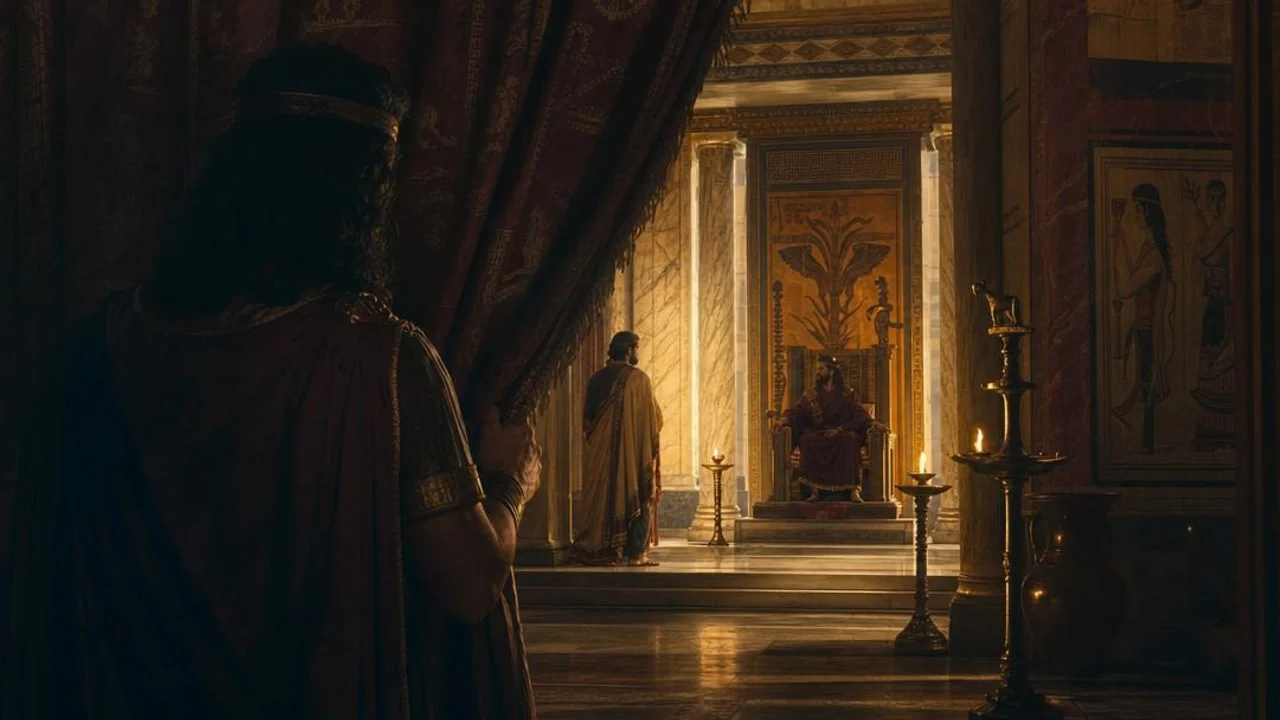
The night begins in a bedroom. A curtain. A king who thinks he owns everything — including the right to display his wife's body to a bodyguard named Gyges. What follows is not only one of antiquity's strangest stories. It is the founding myth of the most powerful dynasty western Anatolia would ever know.
Gyges did not inherit Lydia. He took it. And in doing so, he changed the course of Anatolian history for the next century and a half — while simultaneously setting in motion a prophecy whose fulfillment would bring his dynasty to ruin in the fifth generation.

The man with three names

Before the Greeks called him Gyges (Γύγης), before the Assyrian scribes recorded him in their clay tablets as Gugu of Luddi, the man's Lydian name was Kukas — a word that means "grandfather" in proto-Anatolian languages, shared across Hittite, Luwian, and Lycian. 1
That name was not forgotten after his death. A century later, his great-grandson Alyattes stamped it on coins: Kukalim — "I am of Kukas." In a civilization that had not yet invented biography, this was how dynasties wrote their history. Not in books but in the metal they pulled from the Pactolus River. 1
Gyges reigned from approximately 680 to 644 BC, the first king of the Mermnad dynasty that would culminate in Croesus. He was the son of a man named Dascylus — that is all Herodotus tells us of his origins — and he rose to power as a bodyguard and trusted confidant of the last Heraclid king, Candaules. 2
The Heraclids, who claimed descent from Heracles and the Lydian queen Omphale, had ruled Sardis for over five hundred years. Candaules was their last representative — and he was, by all ancient accounts, a man whose judgment had abandoned him.

The scene at the bedroom door

Herodotus opens his Histories with Lydia. Not with Greece, not with Persia — with Lydia and this story. That placement was not accidental. For the Greeks, Gyges was the hinge on which history turned: the moment the barbarian world became legible, dangerous, and interesting.
The story, as Herodotus tells it, is almost unbearably intimate. 3
Candaules, king of Sardis, had become obsessed with his wife's beauty. He believed — with the certainty of a man who has never had to ask whether his beliefs are true — that she was the most beautiful woman in the world. And he wanted Gyges, his favorite bodyguard, to see this. Not metaphorically. Literally.
"You appear not to believe what I tell you of my lady's beauty," the king told him. "Well, since men trust their ears less than their eyes, I want you to find a way of seeing her naked."
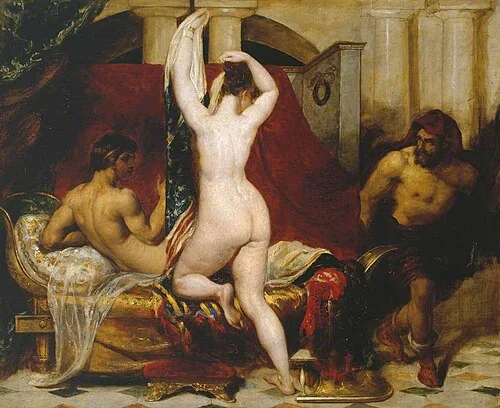
Gyges refused. He pleaded custom: for Lydian women, being seen without clothes meant their honor was stripped too. But Candaules had already made up his mind. That night, he hid Gyges behind the bedroom door. The queen undressed. Gyges watched. He thought he had slipped away unseen.
He had not.
William Etty's 1830 painting depicting Candaules showing his queen to Gyges by stealth
Candaules, King of Lydia, Shews his Wife by Stealth to Gyges (1830), William Etty — Tate Gallery, London 1
The next morning the queen summoned Gyges and gave him a choice that had no good answer: kill Candaules and take the throne, or die here, now, in this room, to protect what had already been seen. She would not have two men alive who knew what her husband had done.
Gyges chose to live. That night, using the same door, the same darkness that Candaules had used for his spectacle, Gyges killed the king and became his replacement — in the bedroom and on the throne.

Three versions of the same night

Ancient history does not give us one account of Gyges. It gives us three — each revealing something different about how power, desire, and transgression were understood across different centuries and cultures. 2
Herodotus's version, written in the 5th century BC, places the responsibility on Candaules. Gyges is coerced at every turn — first by the king, then by the queen. His agency is minimal; the tragedy belongs to the man who could not resist showing off what was not his to show.
Plato's version, told two centuries later in The Republic, is entirely different in spirit. Here Gyges is a shepherd who finds a ring of invisibility in an earthquake-opened cave, uses it to seduce the queen, and kills the king to seize power. Plato uses the story not to talk about Lydia at all, but to pose a philosophical question about human nature: if no one could see what you did, would you still behave justly? The answer, in Glaucon's telling, is no — and that makes Gyges the ancient world's first thought experiment in ethics.
Nicolaus of Damascus, writing in the 1st century BC, drew on the Lydian historian Xanthus for a third version — more political, less mythic. In this account, Gyges was an army officer already under suspicion of disloyalty. He was sent to fetch a bride for Candaules, fell in love with her, and killed the king only after learning the king intended to have him killed first. Here Gyges is not a victim of royal exhibitionism but a man navigating a lethal court, making the most rational move available.
The fact that all three versions end in the same place — Gyges on the throne, queen remarried, Heraclid dynasty extinct — suggests the historians were reconstructing a known historical transition from different cultural angles. The dynastic break was real. How exactly it happened, nobody quite agreed.

Gold from the Pactolus, legitimacy from Delphi

The first thing Gyges did after seizing the throne was not consolidate his army or silence his enemies. He sent delegations to Delphi.
The oracle at Delphi held enormous political weight in the ancient Mediterranean world, and Gyges understood that a usurper's legitimacy required divine endorsement — especially one whose claim rested entirely on the death of his predecessor and the willingness of a widowed queen. The Pythia confirmed his kingship. 1
In return, Gyges sent offerings unlike anything Delphi had seen from a non-Greek ruler. Six mixing-bowls of solid gold, extracted from the Pactolus River at Sardis, weighing thirty talents in total. Herodotus, writing a century later, noted that most of the silver at Delphi in his time still came from Gyges's original dedication — the Gygadas — and remarked that it was impossible to miss. 4
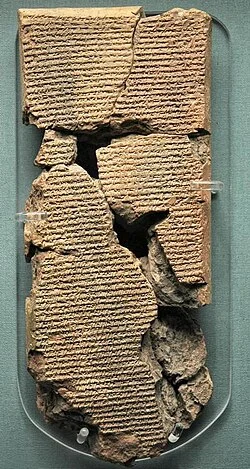
The Gyges Tablet in the British Museum, recording Assyrian diplomatic contact with the king of Lydia
Gyges Tablet, British Museum — Assyrian record of "Gugu of Luddi" (king of Lydia) 1
The Oracle gave him something beyond legitimacy: it gave him a warning. The Pythia declared that the dynasty of Gyges would fall in the fifth generation. Herodotus recorded this prediction with his characteristic restraint, noting that it came true exactly as spoken — four kings later, when Croesus lost Sardis to Cyrus the Great in 546 BC. 2
Whether Gyges took that prophecy seriously or simply filed it away as the distant future's problem, we do not know. He had more immediate work to do.

The warrior king

The Lydia that Gyges inherited was not yet an empire. It was a wealthy city-state in a suddenly dangerous region. The Cimmerians — nomadic steppe warriors who had ridden out of the Eurasian grasslands — had already destroyed Phrygia to the east, creating a power vacuum across central Anatolia. The old world order had collapsed.
Gyges moved fast. He attacked the Ionian Greek cities on the Aegean coast: Miletus, Smyrna, Colophon. He could not conquer Miletus and made peace instead, granting Milesian merchants the right to colonize coastal territories under Lydian control. Smyrna repelled him, but the two cities established a commercial relationship that would last for generations. Colophon he partially took. 1
To the north, he absorbed the Troad — the region around Troy — taking advantage of the Cimmerian destruction of its previous overlords and installing Lydian settlers. He built alliances with the Carian dynasts to the south, alliances maintained through shared religion (the sanctuary of Zeus at Mylasa), shared blood (Gyges's Mermnad dynasty may itself have had Carian connections), and arranged marriages that would continue for the next hundred years.
Around 665 BC, the Cimmerians came for Lydia directly. Gyges defeated them — without, notably, accepting the Assyrian king Ashurbanipal's help, even after a dream in which the Assyrian god Aššur appeared and told him to seek Nineveh's protection. He sent captured Cimmerian soldiers to Ashurbanipal as a gift, but not tribute. He would not be a vassal. 1
Around 662 BC, Gyges made his most geopolitically ambitious move: he sent Carian and Ionian Greek mercenaries to Egypt to help the Saite king Psamtik I reunify the country after the Assyrian withdrawal. The Greek poet Archilochus, writing in this period, had already noted Gyges's wealth with a mixture of admiration and contempt — "I care not for Gyges rich in gold" — suggesting that even in his own lifetime, the Lydian king had become a byword for outlandish fortune.
The Cimmerians returned in 657 BC. Gyges survived. They came again in 644 BC, this time led by their king Lygdamis. This time Sardis fell. Gyges was killed. The Assyrian records — which had been quietly tracking the Lydian king's refusal to become a proper vassal — interpreted his death as divine punishment for his arrogance in acting independently of Assyria. 1
He had ruled for thirty-eight years.

What the usurper built

Gyges's death on the battlefield is not the end of his story — it is the beginning of its consequence.
The dynasty he founded at the point of a knife in Candaules's bedroom would produce four more kings after him: Ardys, Sadyattes, Alyattes, and Croesus. Each generation pushed the Lydian empire further east, refining the gold-purification technology at Sardis's Pactolus workshops, deepening the relations with Greek cities and Delphic sanctuary, extending the walls that the Harvard-Cornell Archaeological Exploration of Sardis has been excavating since 1958 — walls 20 meters thick, built to last. 4
リンクプレビューを読み込んでいます…
Gyges planted the logic of that empire's ambition. He was the first Lydian king to send gifts to Delphi — the first, perhaps second only to Midas of Phrygia, non-Greek ruler to enter the Greek religious economy with serious political intent. He was the first Lydian king recorded in Assyrian clay, a recognition that Sardis had become a force whose movements the great powers of the Near East needed to track.
The oracle's prophecy about his fifth generation was, in retrospect, also a compliment: it assumed the dynasty would last five generations. For a man who took power in a bedroom murder, that was a remarkable vote of confidence.

The Mermnad dynasty would not fall for another 136 years after Gyges's death. The Sacred Blend — those four bloodstreams that the first article of this series traced — had by then produced not just a people but an empire whose collapse would reshape the entire eastern Mediterranean.
Next: Alyattes and the Cimmerian Wars — the son who swept the steppe nomads from Anatolia forever, built the great tomb at Bin Tepe, and accidentally shattered the world of Phrygia to make room for Lydia's golden century.

このコンテンツについて、さらに観点や背景を補足しましょう。

  • ログインするとコメントできます。