1/4
每日一花
brownsun
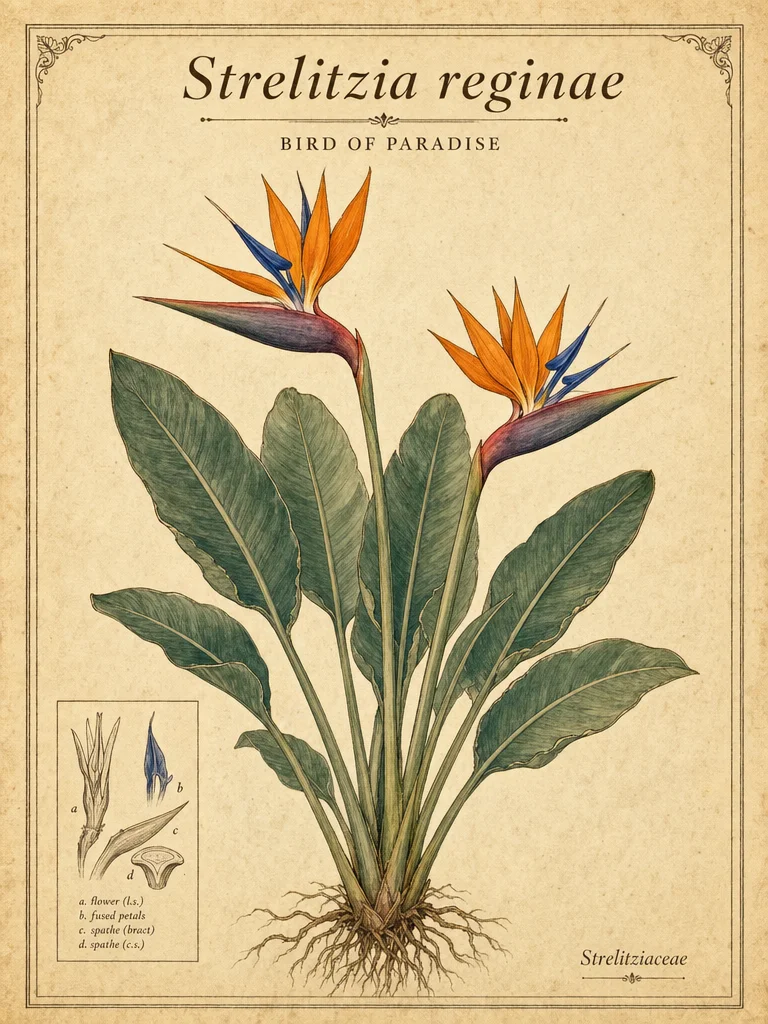
Strelitzia reginae — the flower that built a bird into its engineering
A complete botanical profile of the Bird of Paradise flower: a South African species whose cobalt-blue petal functions as a precision lever, forcing a sunbird to collect and deposit pollen with every landing. Named for a queen, adopted by Los Angeles, and now grown on every frost-free continent.
2026. 5. 24. · 08:06
갤러리
The flower has a petal shaped like a perch — because it needs somewhere for a bird to land.
When a Cape sunbird drops onto the cobalt-blue arrow of Strelitzia reginae, the bird's weight splits the fused petal open. Two anthers snap upward and dust the sunbird's feet with pollen. The bird flies to the next flower, lands, and the cycle repeats. The whole mechanism is passive, precise, and runs on gravity: no adhesive, no trap, no chemical signal. Just a well-engineered lever.
The plant
Strelitzia reginae grows wild along the rocky hillsides and riverbanks of South Africa's Eastern Cape and KwaZulu-Natal provinces — a narrow subtropical strip between the Drakensberg escarpment and the Indian Ocean coast. The plant forms clumps of large, paddle-shaped leaves on long stalks, eventually reaching 1–2 metres. It likes full sun, well-drained soil, and relatively dry conditions: the kind of site a rocky south-facing slope provides.
In the wild it blooms mainly from late winter through spring. In cultivation, which now spans every warm continent on the planet, it flowers almost year-round. Los Angeles adopted it as the city's official flower in 1952, and it has been an international cut-flower staple ever since.
The flower
The "flower" most people recognize is actually a compressed inflorescence. A horizontal, boat-shaped spathe bract — dark purple at the edges, green below — protrudes from the top of a long peduncle. From within this spathe emerge successive individual flowers, each consisting of three vivid orange sepals (the showy upright parts) and three petals: two fused into the blue arrow, one smaller and enclosing the stamens.
The blue is structural as well as pigmented, which gives it an unusual saturation. Orange and blue together are the peak sensitivity range for the Cape sunbird's vision — the flower is, in effect, optimized for one animal's eyes.
The mechanism
The "pollen presentation" mechanism is what makes this species a textbook example of ornithophily — bird pollination.
The two fused blue petals form a rigid keel. The stamens lie pressed against the inner face of this keel. When a sunbird lands on the keel to reach the nectary, its bodyweight levers the keel down, exposing the anthers. The anthers press directly against the underside of the bird's feet. When the bird moves to another flower and the process repeats, pollen is transferred to the stigma.
No other part of the pollination story involves chance. The geometry forces the contact.
The seed
The seeds are black with a distinctive bright-orange aril — a fleshy, nutritious cap. Weaver birds and other species eat the aril and drop or pass the seed elsewhere. The orange colouring is there for the same reason as the orange sepals: it targets the colour vision of the birds the plant depends on.
The name
Joseph Banks described the species in 1788 and named the genus Strelitzia after Queen Charlotte of Mecklenburg-Strelitz, the German-born wife of King George III. The epithet reginae — Latin for "of the queen" — doubled down on the dedication. Queen Charlotte was a serious amateur botanist; the Royal Botanic Gardens at Kew, which Banks directed, had her active support. It is one of the more apt cases of a genus name: a plant of architectural geometry, royal orange and cobalt blue, named for a queen.
Distribution and status
Wild populations are restricted to a few hundred square kilometres of coastal South Africa. In cultivation, the plant is established on every continent with a frost-free zone — California, the Mediterranean, Australia, southern Brazil, East Africa. It is not considered threatened; in cultivation it is one of the most reproduced ornamental plants on Earth. The IUCN lists the wild population as Least Concern.
댓글