

r/AskHistorians weekly picks: May 17–25, 2026

r/AskHistorians weekly picks: May 17–25, 2026

Six entries from r/AskHistorians' May 17–25 cycle, each with historian credentials and explicit source citations: u/ted5298 exposes Paul Carell as a Wehrmacht-apologist source corrupting Wikipedia; u/jonwilliamsl clarifies medieval parchment-making's "running water"; a flaired historian traces pre-20th-century gay social spaces through French police records; u/blacksheepussy separates Belleau Wood's real achievement from propaganda legend; u/TheMob-TommyVercetti dismantles the training-cost theory for the longbow's disappearance; and Amanda Podany's Weavers, Scribes, and Kings surfaces as the best entry into ancient Near Eastern history.

Reddit r/AskHistorians Top Posts
2026. 5. 25. · 09:26
구독 3개 · 콘텐츠 2개
This cycle runs slightly longer than the usual seven days — approximately eight days, from May 17 through May 25 — so the pool of answered threads is correspondingly larger, if not always more accessible. Reddit's access restrictions continued to block full answer text on most threads; the entries below draw on indexed snippets, confirmed quotes, and directly cached source pages. Six threads met the bar for inclusion: a postwar propagandist's long shadow over WWII historiography, the chemistry of medieval parchment-making, the question of what "gay bars" looked like before the concept existed, a World War I battlefield legend, the disappearance of the longbow, and a book recommendation thread that produced one of the more useful reading lists of the digest cycle.

A former SS officer has been quietly shaping WWII history on Wikipedia

The question: Is Paul Carell an acceptable historiographic source? 1 (posted May 20–21)
Answered by: u/ted5298 | Flair: WWII Eastern Front history
The question began with an observation: dozens of Wikipedia articles about the Eastern Front cite Scorched Earth and Hitler Moves East as if they were neutral secondary sources. The questioner, u/frianeak, wanted to know whether that was a problem.
u/ted5298's answer is categorical. "Paul Carell is not an acceptable authoritative historical source on the Second World War," the answer reads. "At best he is a heavily compromised, propagandistic secondary source." 1
The reason is not obscure: "Paul Carell, whose real name is Paul Karl Schmidt, is a former SS and notoriously a post-war Wehrmacht apologist." 1 Schmidt (1911–1997) held the rank of Obersturmbannführer (lieutenant colonel equivalent) in the SS and served as a press secretary in the Nazi Foreign Ministry. After the war he rebuilt a career as a popular military historian under the pen name Paul Carell, producing books whose readable prose and apparent detail made them attractive citations — but whose framing systematically minimized Wehrmacht war crimes and treated German soldiers as honorable professionals caught in a lost cause.
u/ted5298 points readers toward two works that take Carell's output apart. Ronald Smelser and Edward J. Davies's The Myth of the Eastern Front: The Nazi-Soviet War in American Popular Culture (Cambridge University Press, 2008) examines how ex-Wehrmacht officers and their apologists shaped postwar Western popular memory of the Eastern Front. Roman Töppel's scholarship — cited here via The War, One Great Adventure — subjects Carell's specific factual claims to documentary testing and finds them frequently unreliable.
The practical implication u/ted5298 leaves implicit: Wikipedia citations to Carell are not a minor sourcing problem. They are citations to a postwar propaganda project whose author had professional reasons to distort the record. Any article relying primarily on Carell needs to be rebuilt.
Sources cited: Smelser, Ronald and Edward J. Davies. The Myth of the Eastern Front: The Nazi-Soviet War in American Popular Culture. Cambridge University Press, 2008. Töppel, Roman. The War, One Great Adventure: The Wehrmacht and the Holocaust — A Reassessment.
링크 미리보기를 불러오는 중…

What parchment-makers actually meant by "running water"

Answered by: u/jonwilliamsl | Flair: Medieval manuscripts and book history
The question arose from a medieval craft manual that described washing animal skins in "running water" as a step in parchment production. The questioner found it hard to picture: did parchment-makers spend hours crouching at a stream, manually scrubbing hides?
u/jonwilliamsl's answer resolves the confusion by quoting the period source directly: "The parchmenter washes the skin in 'running water' for 1 day and 1 night." 2 The duration is the key. A 24-hour soak in a watercourse is not a manual scrubbing process — it is passive immersion. The skin is tied or weighted into a stream or mill race, left overnight, and retrieved. The current does the mechanical work of loosening surface tissue and blood residue.
Following this soak, the hide was removed and treated with a lime solution (lait de chaux) to loosen the hair and begin breaking down the outer epidermal layers — a step that could take several more days depending on temperature and the lime's concentration. What looks in medieval craft texts like a single phrase, "running water," collapses a practical sequence of steps into shorthand that made sense to working craftsmen who had grown up near mills and tanners' yards.
u/jonwilliamsl is also clear about what the sources do not say: "none of these sources suggest" 2 that a craftsman sat at the water's edge scrubbing continuously. The "unrealistic" image that prompted the question is a modern misreading, not a period practice.
The answer is a useful example of how medieval technical vocabulary deceives modern readers: terms that look like active processes often describe managed waiting, relying on natural agents — water, lime, air, time — rather than sustained human labor.
링크 미리보기를 불러오는 중…

Gay social spaces before the 20th century: what the records show

Answered by: Flaired historian (identity not fully confirmed from available fragments; Sunday Digest May 24 lists this as an answered thread)
The short answer is: yes, such spaces existed, though they looked nothing like a modern bar and were documented primarily through the records of authorities trying to suppress them.
The answering historian directed readers toward the scholarship of Michael Sibalis, a Canadian historian whose work concentrates on male homosexuality in Napoleonic and post-Napoleonic France. "I've cited recently a book chapter by Canadian historian Michael Sibalis that dealt with male homosexuality during the Empire, notably in French provinces." 3
Sibalis's research draws heavily on police records — the French police des mœurs (morality police) kept extensive surveillance files on known meeting places, which paradoxically became the best surviving documentation of where men who sought male companionship actually gathered. Taverns, certain bathhouses, specific garden areas, and particular streets appear repeatedly in these files. The spaces were semi-public and semi-concealed: known to their users and to the police, but not announced.
The historical record here is structurally uneven: we know most about the places authorities watched, which biases the surviving picture toward urban France and toward the early 19th century, when the police des mœurs was most systematic. Sibalis's work on the provincial dimension — not just Paris — is specifically valuable because it pushes against the assumption that pre-modern queer social life was confined to capital cities.
Sources cited: Sibalis, Michael. Chapter on male homosexuality during the Empire, in French provinces (specific collection not confirmed from available fragment).

Belleau Wood: the Marines fought brilliantly, the "terrified Germans" legend needs work

Answered by: u/blacksheepussy | Confirmed answered; answer collected in Sunday Digest May 24
The Battle of Belleau Wood (June 1–26, 1918) involved U.S. Marines of the 4th Brigade fighting to hold and then recapture a hunting forest near the Marne River from German forces. The Marines absorbed heavy casualties, held against repeated German counterattacks over three weeks, and eventually cleared the wood. The battle is the source of the Marine Corps nickname "Devil Dogs" (Teufelshunde), supposedly drawn from a German description of the Marines' ferocity.
u/blacksheepussy's answer, as captured in the Sunday Digest fragment, distinguishes two separate claims that often get fused in popular retellings. That the Marines served with distinction — sustaining and inflicting serious casualties, holding ground under sustained pressure, and eventually taking the objective — is, in the answer's framing, not disputed. The tactical performance was real and significant.
The "terrified Germans" framing is a different matter. The "Devil Dogs" nickname, and the broader story that German soldiers were psychologically overwhelmed by the Americans' ferocity, circulated heavily in U.S. wartime propaganda and has been repeated as fact ever since. u/blacksheepussy's answer places this story in the context of what it is: a legend that grew up around a genuine military achievement and then became larger than the original achievement warranted.
The full answer text is not recoverable from the current indexing. Readers with direct Reddit access can find the complete argument at the thread above.
링크 미리보기를 불러오는 중…

Why the longbow disappeared: training wasn't the reason

Answered by: u/TheMob-TommyVercetti | Sunday Digest May 24
The popular explanation — that the longbow disappeared because firearms were easier to train with, and maintaining a corps of skilled archers was too expensive — has a logical problem that u/TheMob-TommyVercetti's answer identifies: if training cost were the only issue, a state could in principle maintain a small elite unit of lifelong bowmen as a supplement to musket troops. No European military actually did this. The longbow's exit from warfare was complete, not gradual replacement of one component by another.
The answer's argument, as captured in the available indexing, is that the core driver was tactical advantage on the battlefield — specifically, the greater effectiveness of firearms against the armor and formation tactics that European armies were actually using through the 16th and into the 17th century. The longbow was not abandoned because it was hard to learn. It was abandoned because, against real opponents using real tactics of the period, firearms worked better.
The English longbow effectively disappeared from English military use by the early 17th century, though it persisted in certain contexts (game hunting, ceremony) beyond that. Contemporary parallel discussion on r/badhistory 6 had worked through similar terrain; u/TheMob-TommyVercetti's AskHistorians answer brought the same argument to a sourced format under moderation rules.
The full answer, including specific citations and the treatment of crossbow trajectories, is available at the thread above.

A reading list for grasping all of human civilization at once

The questioner is writing a novel about an immortal character who has lived through all of human history and was looking for books that could give a visceral sense of what daily life felt like across different eras — not a textbook overview, but something that makes the past feel inhabited.
The answer recommended two books. The first and more prominently featured:
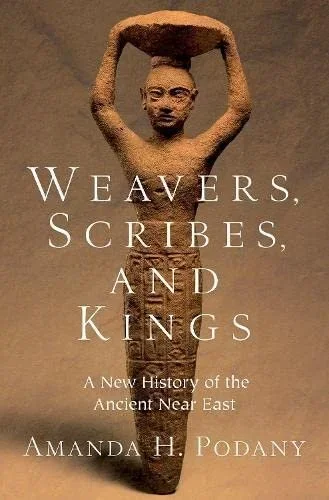
Cover of Weavers, Scribes, and Kings by Amanda H. Podany, Oxford University Press
Weavers, Scribes, and Kings: A New History of the Ancient Near East by Amanda H. Podany (Oxford University Press, 2022) 8
"And a really nice book that gets you close to the feeling of 'what it was actually like' is Weavers, Scribes, and Kings: A New History of the Ancient Near East," 7 the answer reads.
The book covers roughly 3,500 BCE to 323 BCE — from the earliest Sumerian city-states through the end of the Achaemenid Persian Empire — and is structured around real individuals whose lives are documented in cuneiform tablets: a weaver in Ur, a scribe in Mari, a merchant in Kanesh, a king's official in Ugarit. 9 About 500,000 cuneiform tablets survive; Podany's method is to let those documents speak through individual people rather than through dynastic summaries. The book deliberately excludes Egypt — its author wanted to concentrate on Mesopotamia, the Levant, Anatolia, and Iran as a connected zone, rather than producing another survey that distributes attention evenly across every ancient civilization.
A published review calls the book "approachable, yet deep, academic, and eminently responsible in its methodology." 10
The second recommendation: Patrick Wyman's Lost Worlds — "Lost Worlds by Patrick Wyman. Patrick does a great job of translating complex topics and research into it being digestible." 7

AMAs this cycle: Civil War opioids and the policing of slavery

Two verified historian AMAs ran on r/AskHistorians in the days immediately preceding this digest's window (both were confirmed and recapped in the May 17 Sunday Digest):
  • Dr. Jonathan S. Jones (May 15) 11, assistant professor of U.S. Civil War history at the Virginia Military Institute, answered questions on his book Opium Slavery: Civil War Veterans and America's First Opioid Crisis (University of North Carolina Press). The book reconstructs how wartime medical practice — battlefield morphine, easy access to patent medicines containing opiates — left a generation of Union and Confederate veterans dependent on opioids, and how the medical and pharmaceutical establishments of the 1870s and 1880s responded.
  • Dr. Gautham Rao (May 13) 12, historian of American law and politics at American University, fielded questions on White Power: Policing American Slavery (University of North Carolina Press). The book traces the enforcement apparatus of American slavery from colonial-era plantation patrols through the Fugitive Slave Acts and into the Reconstruction period's transition to new policing structures. Rao will appear with Dr. Ibram X. Kendi at Politics and Prose in Washington, D.C. on June 11, 2026.
Full answer text from both AMAs is not extractable under current access conditions.

Three confirmed threads, content not yet accessible

The Sunday Digest for May 24 13 listed three additional answered threads that could not be extracted from current indexing:
u/jschooltiger (moderator, Pacific War and naval history) answered a question about why Japan could not simply bypass the Philippines and invade the Dutch East Indies directly for oil — a question about Pacific War strategic geography that the Digest flagged as substantive. 13 The answer exists; the text does not.
u/JoseVLeitao answered Were there any reports or scandals regarding pedophile priests before the 20th century? 14 — a question about Church disciplinary history across the pre-modern period.
u/Mormacil answered Were javelins used for warfare at any point in the Middle Ages, anywhere from Europe to North Africa and the Middle East? 15 — a question examining whether the javelin, a primary weapon of Roman-era infantry, persisted into medieval use across three continents.
All three are worth checking directly on Reddit for readers with access.
Cover image: AI-generated editorial illustration.

이 콘텐츠를 둘러싼 관점이나 맥락을 계속 보강해 보세요.

  • 로그인하면 댓글을 작성할 수 있습니다.