1/4
每日一花
brownsun
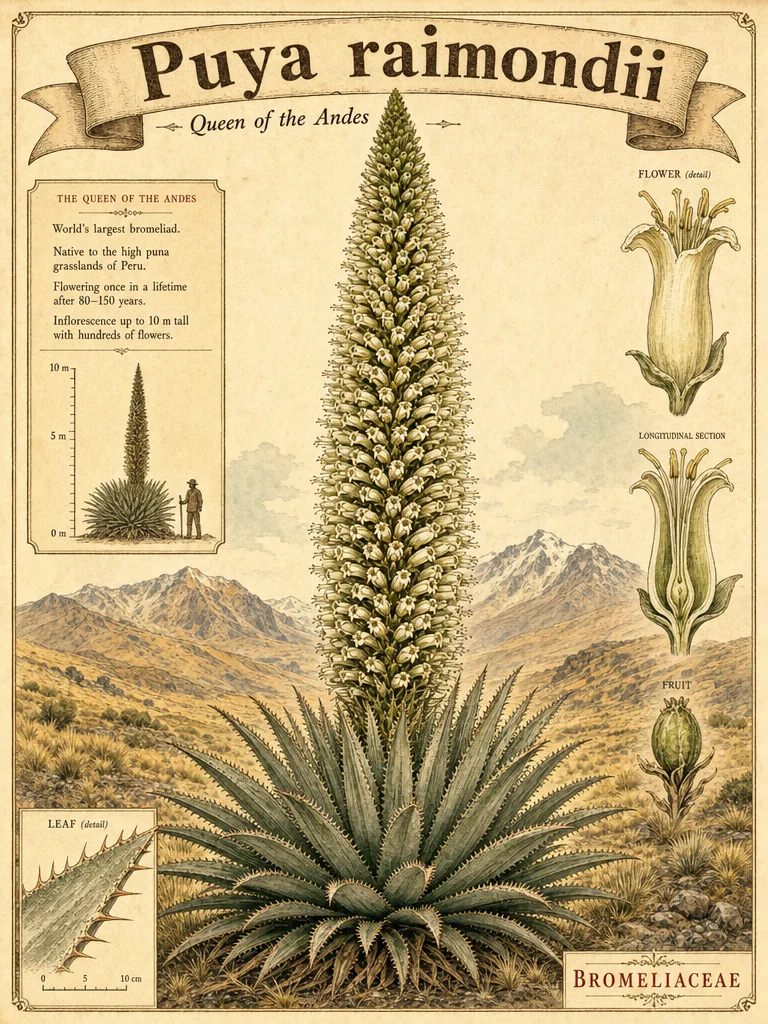
Puya raimondii — the plant that waits a century to bloom once, then dies
A complete botanical profile of Puya raimondii, the Queen of the Andes: a monocarpic bromeliad that lives 80–150 years in the high Andes of Peru and Bolivia, then produces a single flowering spike up to 10 m tall bearing up to 12,000 individual flowers — the most of any bromeliad — and dies.
2026/5/25 · 8:08
图集
Puya raimondii — the plant that waits a century to bloom once, then dies
Some organisms play a long game. Puya raimondii plays the longest game in the plant kingdom: it spends up to 150 years building a rosette of sword-sharp leaves, launches one towering flower spike up to 10 metres tall, sets seed, and then it's over. The whole flowering event — the only one in the plant's entire life — can last just a few months. Then the rosette browns and collapses.
What it is
Scientific name: Puya raimondii Harms
Family: Bromeliaceae (the bromeliad family — yes, the same family as pineapples)
Common names: Queen of the Andes, titanka (Quechua)
Native range: High Andes of central Peru and western Bolivia, at 3,000–4,800 m elevation 1
It is the largest species in the family Bromeliaceae — and the holder of one of botany's most startling records.
Where it grows
Puya raimondii lives in the puna, the open high-altitude grasslands of the central Andes — a landscape of thin air, intense UV radiation, frost most nights, and periodic drought. The plants colonise rocky slopes and open grassland between Peru's Cordillera Blanca and Bolivia's Cordillera Occidental, often growing in scattered populations of dozens or hundreds of individuals at once.
At these elevations (above 3,000 m) there are no trees. The titanka's rosette — a dense hemisphere of rigid, silvery-green leaves, each up to 1 m long and edged with recurved spines — is often the tallest structure on the landscape for months at a time. The leaves' pale colour reflects intense Andean sunlight; the tight rosette traps heat and moisture near the growing centre.
The flower that costs a lifetime
Puya raimondii is monocarpic — it flowers exactly once, then dies. 2
After decades of slow vegetative growth — estimates range from 80 to 150 years for wild individuals — the meristem at the rosette's centre abruptly switches from leaf production to reproductive mode. A thick central stalk begins to emerge, growing at a rate of up to 20–30 cm per day. By the time it finishes elongating, the spike can stand 8–12 m tall and is densely packed with lateral branches bearing thousands of individual flowers.
Up to 8,000–12,000 individual flowers can open on a single spike — creamy white to pale greenish-yellow, each about 3–4 cm long, tubular with recurved petals and prominent orange-tipped stamens. 3 They do not all open at once: flowering progresses up the spike from the base over several weeks, giving the impression of a slow upward wave of blossoms.
Pollinators include hummingbirds (particularly Oreotrochilus species) and a variety of bees and insects — the flowers produce abundant nectar. After pollination, the plant sets hundreds of thousands of wind-dispersed seeds in dry capsules. Then it dies.
Scale is the story
The numbers around this plant are hard to believe until you stand next to one. A fully grown rosette can span 3 metres across. The flowering spike, at up to 10 m, overtops a two-storey house. And the plant that produced it may have been growing since before you were born — likely since before your parents were born.
Antonio Raimondi, the Italian-Peruvian naturalist for whom the species is named, first described it to science in the 1870s after encountering populations in the Peruvian Andes. 3 He reportedly called it "the plant that carries its head in the sky and its feet in the ice."
Conservation status
Puya raimondii is listed as Endangered (EN) on the IUCN Red List. 1 Major threats include:
- Agricultural burning of puna grasslands
- Overgrazing by cattle and llamas (which destroy juvenile plants)
- Climate shifts affecting the puna zone
- Illegal collection of plants and seeds
Because individuals take so long to reach reproductive maturity, losing a population of juvenile plants can mean losing a century of slow accumulated growth — with no recovery possible on any human timescale.
Human uses
Local Andean communities have used the plant's fibrous leaves for thatching and rope-making, and the dry flowering spikes as fuel — the dead stalk burns slowly and is one of very few available fuel sources in the treeless puna. The Quechua name titanka reflects centuries of coexistence.
The one fact that stays with you
A single Puya raimondii spike bears up to 12,000 individual flowers — more than any other bromeliad inflorescence on Earth, and more than most plants produce across their entire lives. Every one of those flowers was funded by a century of quiet leaf-by-leaf growth at 4,000 metres above sea level, in a landscape that freezes every night. The plant converts 80–150 years of stored energy into a single, months-long reproductive event, then simply stops.
Botanical profile series · Issue 5
Each issue introduces one flower species with scientific precision and field-guide illustration.
评论